
 Mushroom Extracts

_1.png) Botanical Extracts
Botanical Extracts
_1.png) Cosmetic Ingredients
Cosmetic Ingredients
_1.png) Prebiotics & Fibers
Prebiotics & Fibers
_1.png) Fruit & Vegetable Powders
Fruit & Vegetable Powders
_1.png) Plant Oils
Plant Oils
_1.png) Specialty Ingredients
Specialty Ingredients
 Ingredient Science
_2.png) Supply chain & Quality
Supply chain & Quality
_2.png) Market Trends & lnnovation
Market Trends & lnnovation
_2.png) Regulations & Compliance
Regulations & Compliance
_2.png) News & Events
News & Events

As we navigate the regulatory landscape of 2026, the global botanical extract industry has reached a pivotal junction. With the European Food Safety Authority (EFSA) and the FDA tightening their default maximum residue levels (MRLs) to a rigorous 0.01 mg/kg [1], the "Safety Gap" between generic extracts and premium standardized ingredients has become a matter of legal survival.
For brands pursuing high-potency formulations—such as 20% Glucoraphanin (Broccoli Seed Extract)—the challenge is not just achieving concentration, but managing the "Concentration Curse."
1. The "Concentration Curse" in High-Spec Extracts
In the quest for 20% standardization, many manufacturers inadvertently concentrate more than just the bioactive molecules. Standardized extraction is essentially a process of magnification. If a raw seed contains even trace amounts of lipophilic pesticides or heavy metals, a 20x concentration process can push those levels far beyond the 0.01 mg/kg "Red Line."
2. The Invisible Risk of Solvent-Assisted Extraction
While "Water-Ethanol" mixtures are common in the industry to increase yield and concentration speed, they introduce two critical risks:
-
Solvent Residue: Even trace amounts of ethanol or secondary solvents can jeopardize a "Clean Label" status under 2026 scrutiny.
-
Pesticide Carry-over: Ethanol acts as a superior solvent for many modern pesticides that are otherwise insoluble in water.
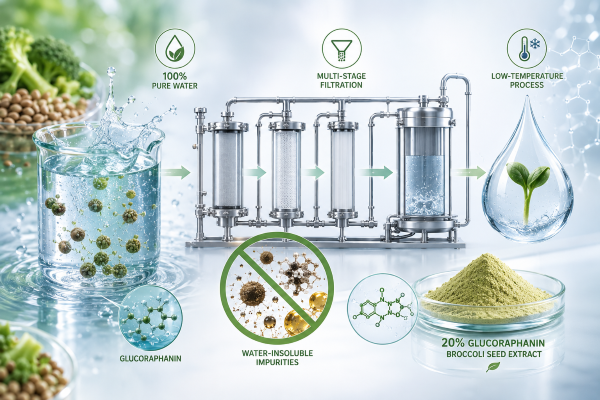
3. The JOY-NATURAL Solution: Physical Pure Water Purification
At JOY-NATURAL, our 20% Glucoraphanin isn't just an extract; it is a product of Physical Purification Technology.
By utilizing a 100% Pure Water Extraction system, we leverage the specific solubility of Glucoraphanin while naturally excluding water-insoluble contaminants. Our process relies on:
-
Advanced Membrane Filtration: Instead of chemical solvents, we use multi-stage physical membranes to concentrate the active molecules.
-
Low-Temperature Environment: Protecting the enzyme precursors and active molecules without the need for chemical stabilizers.
4. Verification over Claims: The ND (Non-Detectable) Standard
For our global B2B partners, the most valuable asset we provide is not a price list, but a Comprehensive Compliance Report. Our batches are screened against the EU 396/2005 [2] and USP <561> [3] pesticide panels, aiming for "ND" (Non-Detectable) status across over 500+ markers.
In the 2026 market, trust is built on what isn't in the powder as much as what is.
References
- EFSA Guidance on the use of the default MRL of 0.01 mg/kg for plant protection products. European Food Safety Authority (EFSA) Journal, updated Jan 2026.
- Regulation (EC) No 396/2005 on maximum residue levels of pesticides in or on food and feed. Official Journal of the European Union.
- USP <561> Articles of Botanical Origin: Pesticide Residue Analysis. United States Pharmacopeia.


 Submitted successfully