
 Mushroom Extracts

_1.png) Botanical Extracts
Botanical Extracts
_1.png) Cosmetic Ingredients
Cosmetic Ingredients
_1.png) Prebiotics & Fibers
Prebiotics & Fibers
_1.png) Fruit & Vegetable Powders
Fruit & Vegetable Powders
_1.png) Plant Oils
Plant Oils
_1.png) Specialty Ingredients
Specialty Ingredients
 Ingredient Science
_2.png) Supply chain & Quality
Supply chain & Quality
_2.png) Market Trends & lnnovation
Market Trends & lnnovation
_2.png) Regulations & Compliance
Regulations & Compliance
_2.png) News & Events
News & Events

The global botanical extract industry has entered a critical regulatory phase. With the European Food Safety Authority (EFSA) and the U.S. Food and Drug Administration (FDA) tightening universal Maximum Residue Limits (MRLs) to a strict 0.01 mg/kg, the safety gap between generic extracts and premium standardized raw materials now dictates whether a brand can legally operate.
At the same time, the industry is re-evaluating ratio extracts (such as 10:1 and 20:1), which were traditionally trusted to deliver specific functional benefits. Are they becoming a hidden risk factor for modern supplement brands?
As the market shifts toward empirical verification, professional buyers are identifying the blind spots of ratio-based sourcing. Let’s look at two industry case studies.
Part 1: Botanical Sourcing Risks: Case Studies in Ratio Extract Failures
Case 1: The Ineffective Glucoraphanin & Product Recall
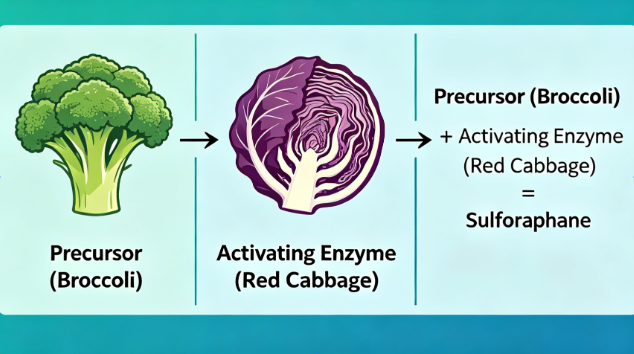
An anti-aging brand formulated a "cellular support" capsule using a 20:1 Broccoli Seed Extract, expecting a high concentration of Glucoraphanin. Post-launch, third-party testing revealed that the active Glucoraphanin content was under 0.05%. The supplier had utilized low-grade, degraded raw seeds. A 20:1 ratio simply meant that 20 kg of inactive waste was concentrated into 1 kg of finished powder.
-
The Outcome: The brand was forced to issue a voluntary product recall, suffering devastating financial losses and irreversible damage to its reputation.
-
The Insight: Extraction ratios only represent the weight relationship between raw starting material and the final yield; they do not guarantee active ingredient content. If the starting material is inactive, even a high concentration ratio yields zero efficacy. Furthermore, ratio compliance relies heavily on supplier self-regulation, making it a quality "black box."
Case 2: The Adulterated "Premium" Mushroom Extract
A beverage brand sourced a 30:1 Reishi Mushroom Extract for an immune-support formula, attracted by a price 50% lower than market-standardized alternatives. During formulation, R&D noted an unusually sweet taste and hyper-solubility. High-Performance Liquid Chromatography (HPLC) testing revealed that maltodextrin made up 75% of the extract.
-
The Outcome: The supplier used a high-temperature solvent process that degraded the delicate $\beta$-glucans in the Reishi, then added massive amounts of excipients to hit the 30:1 weight ratio. The final product failed to meet its label claims for $\beta$-glucan levels. Following poor consumer feedback and a plummeting Net Promoter Score (NPS), a major retail contract was canceled.
-
The Insight: High-temperature processing destroys bioactivity. High ratios are frequently artificially engineered with cheap carriers to mask the lack of active compounds.
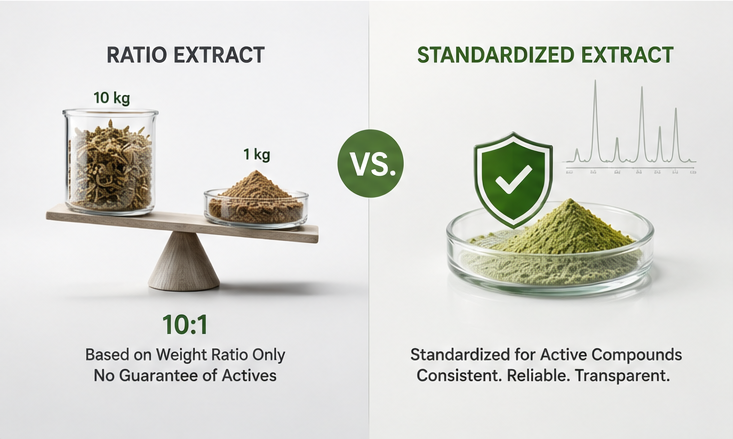
Part 2: Ratio vs. Standardization: The Core Differences
-
What is a Ratio Extract (e.g., 10:1)? It solely measures the weight input-to-output ratio (e.g., 10 kg of raw material yields 1 kg of extract). It does not test for active markers like Glucoraphanin or $\beta$-glucans, making it impossible to guarantee consistent product performance or safety.
-
What is a Standardized Extract (e.g., 20% Glucoraphanin)? It guarantees that the active marker consistently hits a specific percentage verified via HPLC testing. This ensures predictable potency, label compliance, and scalable production.
Part 3: The Cost Trap: Price per Kilo vs. Cost per Dose
A common procurement mistake is evaluating raw materials solely by their price per kilogram. For brand ROI, the true metric is the cost per effective dose.
While standardized extracts carry a higher price per kilo, they often lower the formulation cost per dose because significantly less material is required to meet efficacy targets. Smaller inclusion rates also reduce capsule sizes, shrinking secondary expenses like packaging, excipients, and logistics.
Ratio Extract Cost Per Dose = High Inclusion Volume X Lower Unit Price = High Hidden Costs
Standardized Extract Cost Per Dose = Low Inclusion Volume X Premium Unit Price = Maximized ROI
Part 4: Technical Risks of Relying on Ratio Extracts
-
Batch-to-Batch Potency Fluctuations: Natural variations in crop quality cause active levels to spike or drop between batches, leading to unpredictable product performance for consumers.
-
Excipient Overload: Large raw material requirements balloon capsule volume, forcing formulators to cut other complementary active ingredients and weakening the product's market competitiveness.
-
Compliance Vulnerabilities: In today’s strict regulatory climate, marketing a product based purely on a ratio without declaring verified active markers can be flagged as misleading. This exposes brands to severe legal liabilities and forced recalls.
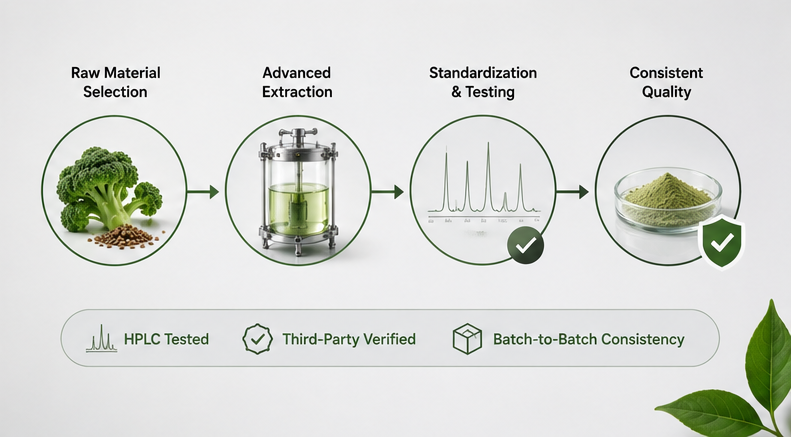
Part 5: Joy-natural: Your Trusted Supplier for Standardized Botanical Extracts
At Joy-natural, we have phased out extraction ratios as primary specifications for our core catalog. We supply exclusively standardized, fully traceable raw materials:
-
Broccoli Seed Extract: Standardized to 13% and 20% Glucoraphanin.
-
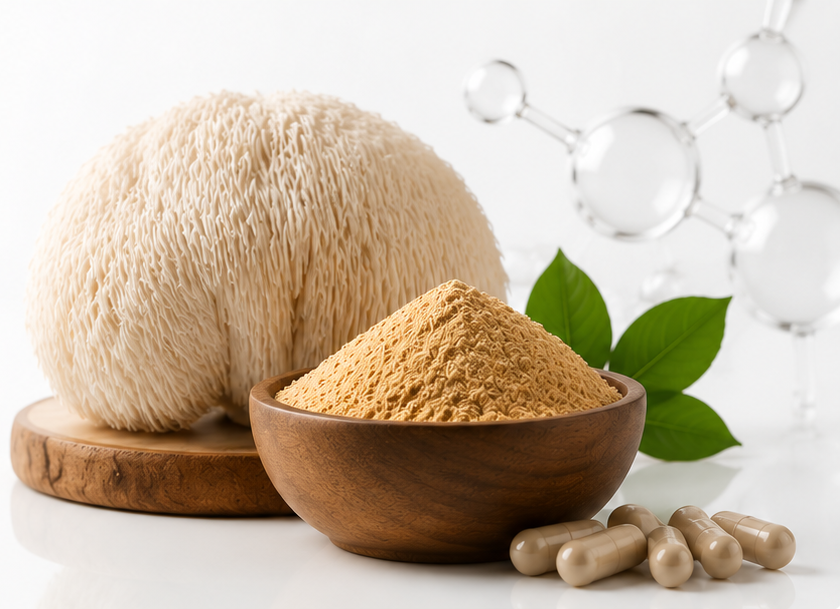
Mushroom Extracts: Standardized to precise levels of $\beta$-glucans and characteristic triterpenes.
Every batch we ship includes a third-party HPLC Certificate of Analysis (COA). We firmly believe that absolute transparency is the best tool for risk mitigation.
Conclusion: Future-Proofing Your Sourcing Strategy
Moving toward 2027, the gap between generic ingredient brokers and technical supply partners will continue to widen. Professional procurement is no longer just about buying powder; it is about risk management and maximizing active value.
Transitioning away from ambiguous ratio sourcing to standardized ingredients protects your R&D investment, optimizes true manufacturing costs, and builds a brand consumers can trust.
Disclaimer: The information in this article is intended solely for B2B procurement and R&D purposes in the dietary supplement industry and does not constitute medical advice. These statements have not been evaluated by the FDA or EFSA. Joy-natural ingredients are not intended to diagnose, treat, cure, or prevent any disease.


 Submitted successfully