
 Mushroom Extracts

_1.png) Botanical Extracts
Botanical Extracts
_1.png) Cosmetic Ingredients
Cosmetic Ingredients
_1.png) Prebiotics & Fibers
Prebiotics & Fibers
_1.png) Fruit & Vegetable Powders
Fruit & Vegetable Powders
_1.png) Plant Oils
Plant Oils
_1.png) Specialty Ingredients
Specialty Ingredients
 Ingredient Science
_2.png) Supply chain & Quality
Supply chain & Quality
_2.png) Market Trends & lnnovation
Market Trends & lnnovation
_2.png) Regulations & Compliance
Regulations & Compliance
_2.png) News & Events
News & Events

The global nutritional supplement market is experiencing an unprecedented regulatory and consumer-driven shift toward clean-label, ethically aligned ingredients. Within the Vitamin D category, formulators have historically relied on animal-derived sources, creating a massive commercial gap for the rapidly expanding plant-based and vegan demographic.
Vitamin D2 Mushroom Powder (Ergocalciferol) has emerged as the premier botanical solution. It unlocks a highly bioavailable, structurally stable, and 100% vegan whole-food framework for modern premium wellness brands looking to satisfy the strict quality and compliance standards of the "Verification Era."
*Check out the detailed information of our Vitamin D2 Mushroom Powder.
Part 1: Molecular Classifications: Vitamin D2 vs. Vitamin D3
To evaluate plant-based vitamin solutions accurately from an R&D standpoint, it is necessary to first master the structural and biochemical differences between the two primary forms of Vitamin D.
1. Vitamin D2 (Ergocalciferol)
-
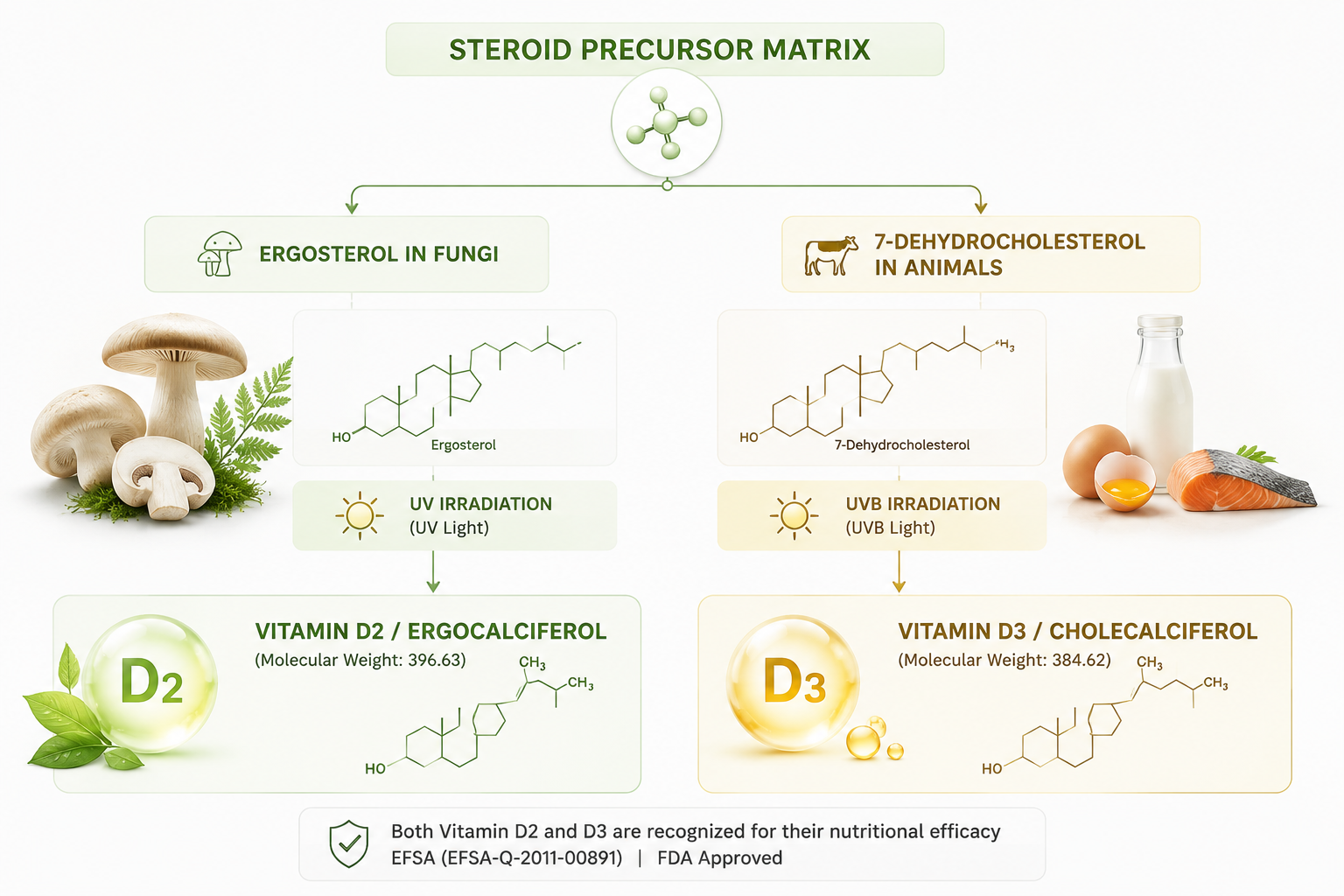
Molecular Profile: It features a chemical formula of $C_{28}H_{44}O$ and a molecular weight of 396.63. Structurally, it is an open-ring secosteroid characterized by a distinctive double bond between carbon atoms 22 and 23 ($C22=C23$), along with a methyl group at position carbon 24 ($C24$) on its hydrocarbon side chain.
-
Natural Source: Found natively and abundantly within the lipid membranes of fungi, mushrooms, and select plant matrices. It is generated through the photochemical cleavage of its plant-based precursor, Ergosterol, under ultraviolet (UV) light exposure.
2. Vitamin D3 (Cholecalciferol)
-
Molecular Profile: It features a chemical formula of $C_{27}H_{44}O$ and a molecular weight of 384.62. It lacks the double bond and the methyl substituent found on the side chain of the D2 analogue.
-
Natural Source: Found almost exclusively in animal infrastructure, sourced predominantly from lanolin (sheep’s wool grease), deep-sea fish liver oils, or egg yolks, synthesized when 7-dehydrocholesterol in animal skin tissue reacts to UVB radiation.
Regulatory Recognition: Both the European Food Safety Authority (EFSA) and the U.S. Food and Drug Administration (FDA) formally recognize mushroom-derived Vitamin D2 as a nutritionally equivalent and highly effective counter-part to Vitamin D3 for daily dietary supplementation and systemic bone mineralization support [1].
Part 2: The Photochemical Synthesis Pathway in Fungi
The conversion of raw mushroom matrices into premium, standardized Vitamin D2 powder mimics a natural ecological process. It relies entirely on a precise, clean-label physical transformation without the introduction of industrial chemical catalysts or synthetic solvents.
-
Ergosterol Matrix Activation: Premium edible mushrooms (Agaricus bisporus) naturally accumulate dense concentrations of Ergosterol within their lipid-rich cell membranes, where it serves as a critical structural component akin to cholesterol in animals.
-
Targeted UVB Irradiation: The raw mushroom powder undergoes controlled light exposure strictly calibrated to a wavelength spectrum of 290 nm – 320 nm (UVB range). This targeted light energy cleaves the 9,10 carbon-carbon bond on the steroid B-ring of the Ergosterol molecule.
-
Thermal Isomerization: The resulting unstable pre-vitamin intermediate spontaneously rearranges under controlled ambient temperatures into stable Vitamin D2 (Ergocalciferol).
Through this physical mechanism, the final powder can be reliably standardized and customized to specific target potencies ranging from 1,000 IU/g to over 5,000 IU/g, fully adapting to varied formulation requirements.
Part 3: Analytical Methodology & Quality Verification
To guarantee absolute label compliance and satisfy global regulatory scrutiny, raw material verification must move beyond generic assays.
-
HPLC-UV Standardization: Every batch of our Vitamin D2 Mushroom Powder is rigorously quantified using High-Performance Liquid Chromatography (HPLC) coupled with an Ultraviolet (UV) detector, strictly aligned with international AOAC and USP standard methodologies. This advanced extraction and testing protocol securely isolates and quantifies the exact Ergocalciferol fractions, ensuring zero cross-contamination or artificial spiking.
-
Physical Parameters Control: * Appearance & Granularity: An ultra-fine, light brown free-flowing powder that integrates seamlessly into dry blending lines.
-
Moisture Threshold: Strictly limited to $< 5.0\%$ through advanced low-temperature dehydration technologies. This prevents premature microbial proliferation and chemical degradation, guaranteeing powder flowability during high-speed encapsulation.
-
Part 4: Technical Comparison: Mushroom Powder vs. Alternative Delivery Forms
When selecting a commercial Vitamin D2 raw material, evaluating the vehicle of delivery is crucial. Fungal-derived mushroom powder offers an unmatched whole-food nutritional and clean-label profile compared to secondary sources:
|
Sourcing Parameter |
Premium Vitamin D2 Mushroom Powder |
Yeast-Derived Vitamin D2 |
Synthetic Crystalline Isolate |
|
Nutritional Delivery Medium |
Whole-Food Fungal Matrix (Cell-wall enclosed Ergocalciferol) |
Processed liquid yeast paste carrier subjected to general UV tanks |
Isolated single chemical crystals ($>99\%$ pure molecules) |
|
Methodology Testing |
Standardized via HPLC-UV (Strictly AOAC / USP aligned) |
Generalized UV tank assaying with higher margin of error |
Chemical purity assaying via raw industrial chromatography |
|
Complementary Nutrients |
Rich Whole-Food Spectrum: Contains natural $\beta$-glucans, plant sterols, trace minerals, and complex amino acids. |
Contains generic yeast proteins; lacks specialized functional fungal fibers. |
Completely stripped molecule; contains zero natural co-factors or minerals. |
|
Allergen & Safety Profile |
Hypoallergenic, 100% Yeast-Free, Gluten-Free, and Dairy-Free. Mild flavor. |
Carries potential yeast allergen flags; may introduce distinct odors into formulas. |
Potential risk of trace petrochemical solvent and heavy metal residues. |
|
Commercial Stability |
Native protection via internal cell-wall chitin (24-month shelf life) |
Highly sensitive to ambient oxidation, light, and heat variations. |
High degradation risk unless coated with artificial chemical stabilizers. |
Part 5: Fungal Chitin Matrix: The Secret to High Stability
A major pain point for formulators working with synthetic Vitamin D2 isolates is their acute vulnerability to environmental degradation. Raw, un-stabilized ergocalciferol crystals break down rapidly when exposed to atmospheric oxygen, ambient moisture, and changing thermal currents.
Vitamin D2 Mushroom Powder solves this problem through natural structural encapsulation:
-
The Chitin Shield: Within our standardized powder, the synthesized Ergocalciferol molecules remain securely embedded inside the protective, complex cellular wall of the fungus, which is natively composed of a dense chitin and β-D-glucan complex.
-
Oxidative Resistance: This organic cellular architecture acts as a natural shield, preventing oxygen molecules from directly contacting the active vitamin fractions.
-
Extended Shelf Life: Consequently, the whole-food matrix exhibits superior ambient stability, delivering a consistent 24-month commercial shelf life with minimal potency loss. This completely eliminates the need for synthetic protective coatings or added synthetic preservatives in your final clean-label formulation.
Part 6: Premium Formulation & Application Scenarios
Thanks to its exceptional environmental stability, whole-food classification, and rich nutritional co-factors, Vitamin D2 Mushroom Powder seamlessly adapts to a wide variety of advanced formulation categories:
-
Vegan Hard-Gel Capsules & Compressed Tablets: Integrates cleanly into anhydrous powder blends, offering an effortless way to achieve high-potency label claims with low inclusion volumes.
-
Clean-Label Functional Superfoods: Perfectly suited for plant-based meal replacements, green nutritional shakes, and vegan protein powders looking to add certified organic, food-based vitamin claims.
-
Immune & Bone Support Complexes: Works synergistically with plant-derived Calcium vectors, Magnesium, and Zinc to create premium, comprehensive bone health and systemic biological response formulas.
Technical FAQ (Frequently Asked Questions)
Q1: Is mushroom-derived Vitamin D2 as effective as animal-derived Vitamin D3?
A: Yes. From a scientific and metabolic standpoint, major global authorities including the European Food Safety Authority (EFSA) have evaluated the clinical evidence and formally concluded that Vitamin D2 and Vitamin D3 demonstrate equal nutritional efficacy within standard daily dietary supplementation frameworks (EFSA-Q-2011-00891).
Q2: Why is the moisture content restricted to less than 5.0% in Joy-Natural’s powder?
A: Tight moisture control is essential for maintaining both physical flowability and biological stability. By restricting moisture to $<5.0\%$ via proprietary dehydration, we effectively prevent premature microbial degradation and ensure that the powder does not clump during high-speed industrial encapsulation lines.
Q3: Does the mushroom powder alter the taste or color profile of functional foods?
A: At recommended therapeutic inclusion rates, our highly refined mushroom powder incorporates smoothly into functional food bases. It delivers a neutral to very mild earthy note that is easily masked by standard natural flavors, making it an ideal option for delicate formulations like plant-based milks and clean-label protein powders.
References (Verified Scholarly Sources)
[1] EFSA Panel on Dietetic Products, Nutrition and Allergies (NDA). (2016). Dietary Reference Values for vitamin D. EFSA Journal, 14(10), 4547. EFSA-Q-2011-00891
[2] Cardwell, G., et al. (2018). A Review of Mushrooms as a Potential Source of Dietary Vitamin D. Nutrients, 10(10), 1498. PMC ID: PMC6213178
[3] Keegan, R. J., et al. (2013). Photobiology of vitamin D in mushrooms and its bioavailability in humans. Dermato-Endocrinology, 5(1), 165-176. DOI: 10.4161/derm.23321
[4] Holick, M. F., et al. (2008). Vitamin D2 is as effective as vitamin D3 in maintaining circulating concentrations of 25-hydroxyvitamin D. The Journal of Clinical Endocrinology & Metabolism, 93(3), 677-681. PubMed ID: 18089691
[5] Taofeeq, O., et al. (2017). Mushroom extracts and compounds as functional ingredients and nutraceuticals with immune-enhancing properties. Trends in Food Science & Technology, 70, 15-27. DOI: 10.1016/j.tifs.2017.09.011
Compliance & Regulatory Disclaimer
B2B Disclaimer: This document is intended exclusively for R&D professionals, cosmetic chemists, and dietary supplement manufacturers. It is not intended for direct consumer use or medical advice. The ingredients and scientific pathways described are not intended to diagnose, treat, cure, or prevent any disease. Final brand owners are fully responsible for ensuring that all finished product structure-function claims comply with their local regulatory jurisdictions (such as DSHEA under U.S. FDA or EFSA regulations in the European Union).


 Submitted successfully